At the centre of Madurai stands a temple that has shaped the city's identity for centuries, revealing a remarkable world of art, devotion, and Dravidian craftsmanship.
Worth knowing
Meenakshi Amman Temple is not a monument preserved in time. It is a living place of worship, where daily rituals, the annual Chithirai festival, and generations-old traditions continue to form the spiritual and cultural heart of Madurai.
Meenakshi Amman Temple, Madurai: The Sacred Heart of Tamil Nadu
At the centre of Madurai stands a temple that has shaped the city's identity for centuries. Its towering gateways rise above the old streets, their surfaces covered in colourful figures of gods, goddesses and mythical beings. Within them, a maze of pillared halls, shrines and courtyards unfolds, revealing a remarkable world of art, devotion and craftsmanship.
Meenakshi Amman Temple is dedicated to Goddess Meenakshi, an incarnation of Parvati, and Lord Sundareswarar, a form of Shiva. For the people of Madurai, it is far more than an architectural landmark. It remains the spiritual and cultural heart of the city, with daily rituals, festivals and traditions continuing much as they have for generations.
The Story of Goddess Meenakshi
The temple's history is inseparable from the story of the goddess herself. According to Hindu mythology, Meenakshi was born to the Pandya king Malayadhwaja and his queen Kanchanamalai. She was born with three breasts, and a prophecy foretold that the third would disappear when she met the person she was destined to marry.
Raised as a princess and trained as a warrior, Meenakshi eventually became a powerful ruler. During her travels, she encountered Lord Shiva, and the prophecy came true. Her third breast disappeared, and she recognised him as her divine consort.
Shiva arrived in Madurai in the form of Sundareswarar, and their wedding became one of the defining stories of the city. The celestial marriage is still celebrated every year during the Chithirai festival, when thousands of devotees gather for elaborate ceremonies and processions.
The prominence given to Goddess Meenakshi makes this temple particularly distinctive. Her shrine occupies a central place in the complex, reflecting the importance of the feminine divine in Tamil religious tradition.
An Expression of Dravidian Architecture
The temple is one of the finest examples of the Dravidian architectural tradition. Its most striking features are the gopurams, or monumental gateway towers, which dominate the surrounding cityscape.
There are 14 gopurams within the complex, each rising in tiers covered with sculptures depicting Hindu deities, celestial figures, animals and characters from mythology. Painted in vivid colours, these figures create an extraordinary visual display. The southern gopuram, rising approximately 52 metres, is the tallest of the temple's towers.
Although the temple has ancient origins, much of its present form took shape through successive periods of construction and restoration. The Pandya rulers were among its early patrons, while the Nayak dynasty, particularly under King Thirumalai Nayak in the seventeenth century, played a significant role in expanding and shaping the complex.
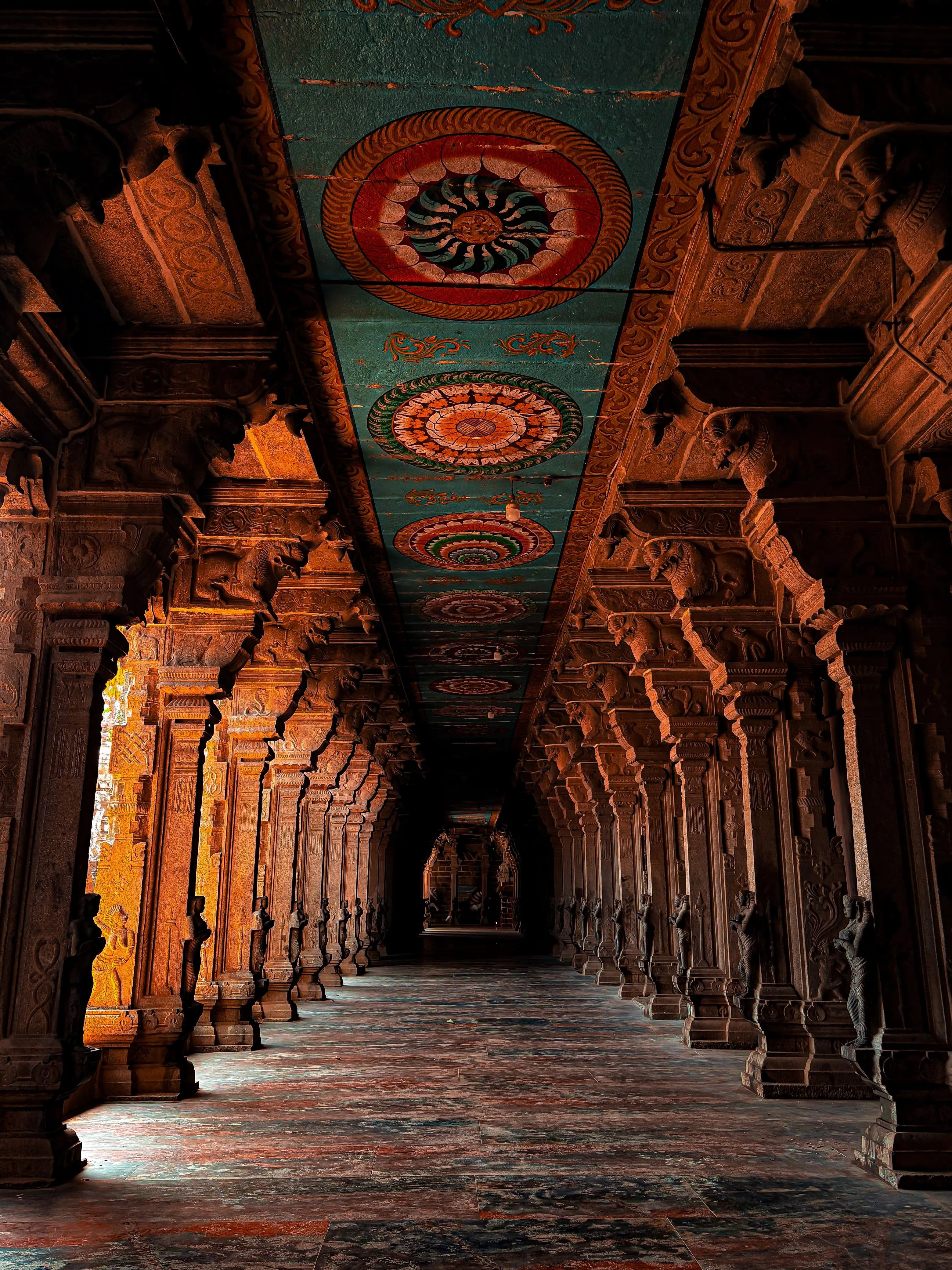
Beyond the gateways, the architecture reveals itself in a succession of pillared halls, carved columns, courtyards and smaller shrines. The scale is impressive, but it is the attention to detail that makes the temple particularly rewarding to explore.
The Hall of a Thousand Pillars
Among the temple's most celebrated spaces is the Ayiramkaal Mandapam, commonly known as the Hall of a Thousand Pillars. It contains 985 pillars, each distinguished by its carvings and sculptural details.
The columns feature figures from Hindu mythology, including deities, guardians and legendary characters. Their arrangement creates an impressive sense of symmetry, while the craftsmanship reflects the artistic skill of the period in which the hall was built.
The hall also houses a museum displaying sculptures and objects connected to the temple's history. Of particular interest are the musical pillars, carved from stone and designed to produce different musical notes when struck gently. They offer a glimpse into the remarkable understanding of material and acoustics possessed by the artisans of the time.
The Golden Lotus Tank
Within the temple complex lies the Potramarai Kulam, or Golden Lotus Tank. Surrounded by stone corridors and pillared walkways, this sacred tank has its own place in the temple's mythology.
According to tradition, Lord Shiva blessed the waters and declared that no fish or other aquatic creatures would inhabit them. The tank is also associated with Tamil literary history. Legend holds that it served as a place where the merit of literary works was tested.
Today, it remains an important gathering place for devotees and a quieter corner of the temple. The reflections of the surrounding architecture on the water offer a different perspective of the complex.
A Temple That Lives Through Its Rituals
Meenakshi Amman Temple is not a monument preserved in time. It is a living place of worship, where the rhythm of the day is shaped by prayers, ceremonies and offerings.
Daily rituals are performed at the shrines of Meenakshi and Sundareswarar, drawing devotees from Madurai and beyond. The temple calendar is marked by festivals throughout the year, but the most important is the annual Chithirai festival, usually held in April or May.
The celebrations include the ceremonial wedding of Meenakshi and Sundareswarar, accompanied by processions, music and religious observances. The festivities extend into the streets of Madurai, bringing together the temple and the city in a celebration that has been passed down through generations.
These traditions are central to understanding the temple. Its architecture tells one story, but its rituals reveal how deeply it continues to be woven into the life of Madurai.
Exploring Meenakshi Amman Temple
A visit to the temple deserves time. Rather than moving quickly from one landmark to another, take the opportunity to notice the details: the sculpted figures on the pillars, the painted gateways, the patterns of light across the corridors and the quiet moments of devotion within the shrines.
As an active place of worship, the temple has specific customs for visitors. Modest clothing is expected, and respectful behaviour is essential. Photography restrictions apply within the complex, and visiting arrangements can change during festivals and special occasions. It is worth checking the latest timings and entry guidelines before your visit.
Beyond the Temple: Discovering Madurai
Meenakshi Amman Temple may be the heart of Madurai, but it is only the beginning of the city's story. Beyond its magnificent gopurams lie historic palaces, ancient shrines, traditional markets, celebrated food traditions and neighbourhoods that have retained their character over generations.
A visit to Madurai should leave room for all of it. With AndThen, the experience extends beyond the temple, bringing together the city's architecture, history, culture and everyday life in a thoughtfully designed private journey.
For those wishing to explore further, AndThen's Temple Trails offer a wider journey through the sacred architecture and cultural heritage of South India, connecting remarkable temples and historic towns across the region.
Explore Madurai in its entirety, or follow the Temple Trail to discover more of South India's extraordinary temple heritage.
Thinking about India?
Tell us what you’re imagining and one of our specialists will come back to you swiftly with an initial outline, built around your dates, interests and pace.